Call us 24/7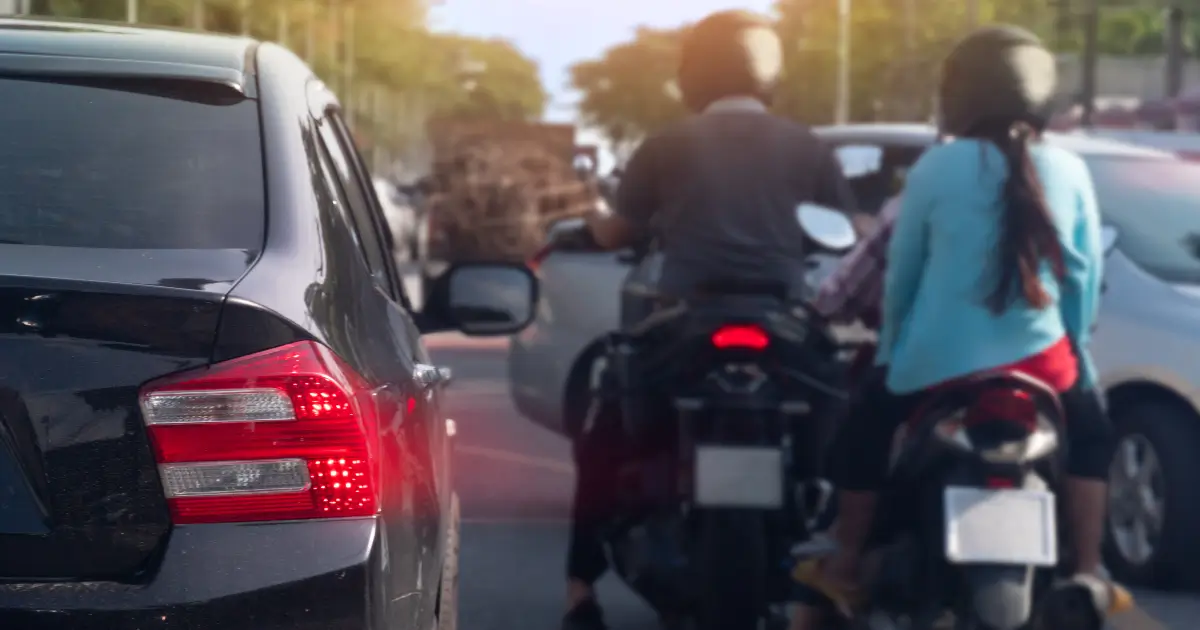
No. Lane splitting is not legal in New York. Under New York Vehicle and Traffic Law § 1252, motorcyclists are prohibited from passing another vehicle in the same lane and from riding between lanes of traffic or between adjacent rows of vehicles.
A motorcycle rider generally cannot ride between cars in stopped traffic, slow traffic, highway congestion, or traffic backups on Long Island, in New York City, or anywhere else in New York State.
But here is the important part: if you were injured in a motorcycle accident and someone claims you were lane splitting, that does not automatically mean you have no case. New York follows comparative negligence rules, which means fault can be shared between multiple parties. A driver may still be responsible if they changed lanes unsafely, failed to check their mirrors, opened a door into traffic, made a dangerous left turn, or failed to see a motorcycle that was there to be seen.
At The Bongiorno Law Firm, we understand how quickly insurance companies try to blame motorcyclists. Our job is to investigate what really happened, protect your rights, and fight for the full compensation you may be entitled to under the law.
Injured in a motorcycle accident in New York? Contact The Bongiorno Law Firm today.
Quick Facts about lane splitting in New York
- Is lane splitting legal in New York? No. Lane splitting is illegal in New York under VTL § 1252(b) and VTL § 1252(c).
- Is lane filtering legal in New York? No. New York does not generally allow motorcycles to ride between stopped or slow-moving vehicles, even if traffic is backed up.
- Can a motorcyclist still have a case if lane splitting is alleged? Yes. A rider may still have a case if another driver also caused or contributed to the crash.
- Does lane splitting automatically make the motorcyclist at fault? No. Lane splitting can affect liability, but fault depends on the facts of the crash.
- Can the insurance company blame the rider? Yes, and they often do. But an insurance company’s accusation is not the same as proof.
What is lane splitting?
Lane splitting usually means a motorcycle rides between two lanes of traffic moving in the same direction. This often happens when cars are stopped, moving slowly, or backed up in traffic.
For example, a rider may try to move between vehicles on the Long Island Expressway, the Southern State Parkway, the Northern State Parkway, the Belt Parkway, Queens Boulevard, Sunrise Highway, Hempstead Turnpike, or a congested street in Brooklyn, Queens, Manhattan, Nassau County, or Suffolk County.
Lane splitting is different from a regular lane change. A legal lane change means the motorcycle moves from one full lane into another full lane when it is safe to do so. Lane splitting means the motorcycle travels between lanes or between vehicles instead of occupying a full traffic lane.
What is lane filtering?
Lane filtering usually refers to a motorcycle moving between stopped or very slow vehicles, often to get to the front of traffic at a red light.
Some riders think lane filtering is different from lane splitting because filtering usually happens when traffic is stopped. But under New York law, that distinction usually does not help the rider. New York does not create a broad legal exception for lane filtering.
Because VTL § 1252(c) prohibits motorcycles from operating between lanes of traffic or between adjacent lines or rows of vehicles, lane filtering can still violate New York law.
What does New York Vehicle and Traffic Law § 1252 say?
New York’s main motorcycle lane law is New York Vehicle and Traffic Law § 1252, titled “Operating motorcycles on roadways laned for traffic.”
The law includes several important rules.
Motorcycles are entitled to full use of a lane
Under VTL § 1252(a), motorcycles are entitled to the full use of a lane. Drivers are not allowed to crowd a motorcycle, squeeze a rider, or operate their vehicle in a way that deprives a motorcyclist of full lane use.
This is important because many drivers treat motorcycles as if they do not belong in a traffic lane. They do. A motorcycle has the same right to occupy a lane as any other vehicle.
Motorcyclists cannot pass another vehicle in the same lane
Under VTL § 1252(b), the operator of a motorcycle may not overtake and pass in the same lane occupied by the vehicle being overtaken.
In plain English, a rider cannot pass a car while staying inside the same lane as that car.
Motorcyclists cannot ride between lanes or rows of vehicles
Under VTL § 1252(c), no person may operate a motorcycle between lanes of traffic or between adjacent lines or rows of vehicles.
This is the section most directly connected to lane splitting and lane filtering.
Two motorcycles may ride side by side
Under VTL § 1252(a) and VTL § 1252(d), motorcycles may ride two abreast in one lane. However, motorcycles may not ride more than two abreast in a single lane.
Police officers have a limited exception
Under VTL § 1252(e), certain restrictions do not apply to police officers acting in the performance of their official duties.
Why is lane splitting illegal in New York?
Lane splitting can be dangerous because drivers may not expect a motorcycle to pass between vehicles. In heavy New York traffic, a motorcycle can be difficult to see, especially when it is moving between cars, trucks, buses, taxis, rideshares, and delivery vehicles.
Common dangers include:
- A driver changes lanes without signaling.
- A driver fails to check mirrors or blind spots.
- A passenger opens a door into traffic.
- A car drifts in stop-and-go-traffic.
- A truck blocks visibility.
- A vehicle turns left across the rider’s path.
- A driver merges suddenly.
- A rideshare passenger exits into the rider’s path.
- A distracted driver fails to see the motorcycle.
- A rider is squeezed between two vehicles.
Motorcyclists have far less protection than people inside cars. Even a low-speed impact can throw a rider to the pavement and cause serious injuries.
For more on visibility-related crashes, read our blog on why drivers fail to see motorcycles in New York accidents.
Can I still sue if I was lane splitting when the accident happened?
Possibly, yes. Lane splitting does not automatically prevent an injured motorcyclist from bringing a claim.
This is one of the most important points for injured riders to understand. Insurance companies often act as if any allegation of lane splitting ends the case. That is not always true.
New York follows a comparative negligence rule under CPLR § 1411. In general, if an injured person is partly responsible for an accident, that does not automatically bar recovery. Instead, damages may be reduced by the percentage of fault assigned to that person.
For example, if a motorcyclist is found partially at fault because lane splitting was involved, but a driver is also found at fault for changing lanes without looking, the rider may still be able to recover a portion of the damages.
Every case depends on the facts.
What is comparative negligence in a motorcycle accident case?
Comparative negligence means more than one person can share fault for an accident.
In a motorcycle lane splitting case, the insurance company may argue that the rider was negligent because lane splitting is illegal in New York. But the rider may argue that the driver was also negligent because the driver failed to use reasonable care.
A driver may share fault if they:
- Changed lanes without signaling.
- Failed to check mirrors.
- Failed to check blind spots.
- Opened a door into traffic.
- Made an unsafe left turn.
- Drifted out of the lane.
- Drove while distracted.
- Failed to yield.
- Followed too closely.
- Failed to see what was there to be seen.
The key question is not only whether lane splitting happened. The key question is: what caused the crash?
If the driver’s negligence contributed to the crash, the rider may still have a valid claim.
How can lane-splitting affect fault?
Lane splitting can become a major issue in determining fault because it may be considered evidence that the rider violated New York traffic law.
The insurance company may argue:
- The rider was riding between lanes.
- The rider was passing vehicles illegally.
- The rider was moving too fast for traffic conditions.
- The rider created a dangerous situation.
- The rider caused the crash.
But the rider’s attorney may investigate whether the driver also violated the law or acted carelessly.
Important questions include:
- Was the motorcycle actually lane splitting?
- Was the rider between lanes or fully inside a lane?
- How fast was the motorcycle traveling?
- Were cars stopped or moving?
- Did the driver signal before changing lanes?
- Did the driver check mirrors and blind spots?
- Did the driver open a door into traffic?
- Did the driver make an unsafe left turn?
- Did the police issue any tickets?
- Is there dash camera, traffic camera, or surveillance video?
The facts matter. The evidence matters. The details matter.
Can the insurance company blame me for lane splitting?
Yes. Insurance companies often blame motorcyclists, especially when lane splitting is alleged.
They may try to say the rider was reckless, speeding, weaving through traffic, or responsible for the entire crash. They may use the police report, a traffic ticket, a driver’s statement, or incomplete witness information to deny or reduce the claim.
But insurance companies do not get the final word.
Many motorcycle accident claims require a deeper investigation. The driver may have changed lanes without looking. A door may have opened suddenly. A car may have made a dangerous left turn. A truck may have blocked visibility. A rideshare vehicle may have stopped unexpectedly. A distracted driver may have failed to see the motorcycle.
Before accepting blame, speak with an attorney who understands New York motorcycle accident cases.
If an insurance company is trying to blame you after a motorcycle crash, contact The Bongiorno Law Firm for a free consultation.
What if the driver says, “I never saw the motorcycle”?
Drivers often say they never saw the motorcycle. That does not automatically excuse the driver.
Drivers in New York have a duty to keep a proper lookout, use their mirrors, check blind spots, signal before changing lanes, yield when required, and avoid unsafe turns or movements.
Many motorcycle accidents happen because drivers fail to see riders until it is too late. This is especially common in:
- Left-turn crashes.
- Lane change accidents.
- Dooring accidents.
- Intersection crashes.
- Merging accidents.
- Parking lot crashes.
- Highway congestion.
- Stop and go traffic.
If the crash involved a left turning vehicle, read our guide to left turn motorcycle accidents in New York.
If the crash involved a door opening into the rider’s path, read our blog on liability for motorcycle dooring accidents in NYC.
Can a motorcyclist get a ticket for lane splitting in New York?
Yes. A motorcyclist may receive a traffic ticket if police believe the rider violated VTL § 1252 by passing in the same lane or riding between lanes or rows of vehicles.
A ticket can also affect the injury claim because the insurance company may use it as evidence that the rider was negligent.
But a ticket does not always tell the whole story. The officer may not have seen the crash happen. The ticket may be based on statements from the driver or witnesses. Other traffic violations may also have contributed to the accident.
That is why the crash should be investigated fully.
What if the crash happened in stopped or slow-moving traffic?
Even if traffic was stopped or moving slowly, lane splitting or lane filtering can still be illegal in New York.
Riders may believe it is safer to move between stopped vehicles than to remain behind traffic. But New York law generally does not allow motorcycles to travel between lanes or rows of vehicles.
That said, if a crash occurs in stopped traffic, fault still depends on what happened.
For example:
- Did a passenger suddenly open a door?
- Did a driver change lanes without looking?
- Did a vehicle move unexpectedly?
- Was the rider traveling slowly?
- Was the driver distracted?
- Was there a rideshare, taxi, delivery truck, or bus involved?
- Was there video footage?
A rider accused of lane splitting may still have a claim if someone else acted negligently.
Are lane splitting accidents common on Long Island and in New York City?
Lane splitting issues often come up in areas with heavy traffic and narrow spaces between vehicles. These cases may happen on highways, parkways, bridges, tunnels, city streets, and major commercial roads.
Common areas where motorcycle crashes may occur include:
- The Long Island Expressway.
- The Southern State Parkway.
- The Northern State Parkway.
- Sunrise Highway.
- Hempstead Turnpike.
- Jericho Turnpike.
- The Belt Parkway.
- The Grand Central Parkway.
- The Brooklyn Queens Expressway.
- Queens Boulevard.
- Manhattan avenues.
- Congested roads in Nassau County and Suffolk County.
Heavy traffic does not excuse unsafe driving. Drivers still have to check before turning, merging, opening doors, or changing lanes.
What injuries happen in lane splitting motorcycle accidents?
Motorcycle accidents can cause devastating injuries because riders have little protection from the impact, the pavement, and surrounding vehicles.
Common injuries include:
- Traumatic brain injuries.
- Concussions.
- Skull fractures.
- Spinal cord injuries.
- Neck injuries.
- Back injuries.
- Herniated discs.
- Broken bones.
- Shoulder injuries.
- Knee injuries.
- Road rash.
- Facial injuries.
- Internal injuries.
- Nerve damage.
- Amputations.
- Psychological trauma.
- Wrongful death.
Under New York Vehicle and Traffic Law § 381, motorcycle operators and passengers must wear an approved protective helmet. Helmet use can become an issue in motorcycle injury cases, especially when head injuries are involved.
What should you do after a motorcycle crash involving lane splitting?
If you were involved in a motorcycle crash, take immediate steps to protect your health and your potential claim.
- Call 911.
- Request medical attention.
- Make sure a police report is prepared.
- Report all pain and symptoms.
- Take photos of the motorcycle, vehicles, road, lane markings, traffic signals, debris, skid marks, and injuries.
- Get witness names and contact information.
- Look for traffic cameras, dash cameras, home cameras, and business surveillance cameras.
- Save your helmet, jacket, gloves, boots, and damaged gear.
- Do not admit fault.
- Do not argue with the driver.
- Do not give a recorded statement to insurance before speaking with an attorney.
- Follow your medical treatment plan.
- Contact a New York motorcycle accident lawyer as soon as possible.
For a full guide, read what to do after a motorcycle crash on Long Island or in New York.
How do you prove fault in a lane splitting motorcycle accident?
Proving fault requires evidence. In motorcycle accident cases, evidence can disappear quickly, especially video footage and witness memories.
Important evidence may include:
- Police accident reports.
- Traffic camera video.
- Dash camera footage.
- Surveillance video from nearby businesses or homes.
- Witness statements.
- Scene photos.
- Vehicle damage.
- Motorcycle damage.
- Helmet and gear damage.
- Roadway layout.
- Lane markings.
- Skid marks and debris.
- Medical records.
- Cell phone records, when relevant.
- Accident reconstruction analysis.
- Insurance documents.
A strong investigation can help determine whether the rider was actually lane splitting, whether the driver acted negligently, and whether fault should be shared.
Why you should not let the insurance company control the story
After a motorcycle crash, the insurance company may quickly create a narrative that blames the rider. This is especially true if the rider was on a motorcycle; the crash happened in traffic, or lane splitting is mentioned in the police report.
But the first version of the story is not always true.
A serious motorcycle accident claim should be built on evidence, not assumptions. The Bongiorno Law Firm investigates the details, reviews the law, speaks with witnesses, analyzes insurance coverage, and fights back when insurance companies unfairly blame injured riders.
Speak with a New York motorcycle accident lawyer
If you were injured in a motorcycle accident in New York, especially one involving lane splitting, lane filtering, a lane change, a dooring accident, a left turn, or a driver who failed to see you, The Bongiorno Law Firm can help.
For more than 40 years, our firm has been trusted by injured New Yorkers and their families. We know how serious motorcycle accidents can be. We know how insurance companies defend these claims. And we know how to fight for riders who have been seriously hurt.
To learn more, visit our New York Motorcycle accident Lawyer practice area page.
You can also read our related motorcycle accident resources:
Left Turn Motorcycle Accidents in New York
What to Do After a Motorcycle Crash on Long Island or in New York
Liability for Motorcycle Dooring Accidents in NYC
The Bongiorno Law Firm
We Care. We Fight. You Win.
FAQ: Is Lane Splitting Legal in New York?
Is lane splitting legal in New York?
No. Lane splitting is illegal in New York. Under New York Vehicle and Traffic Law § 1252(b) and § 1252(c), motorcyclists may not pass another vehicle in the same lane or operate between lanes of traffic or between adjacent rows of vehicles.
Is lane filtering legal in New York?
No. Lane filtering is generally not legal in New York. Even if traffic is stopped or moving slowly, a motorcyclist may not ride between lanes or rows of vehicles.
Can motorcycles ride side by side in New York?
Yes. Motorcycles may ride two abreast in one lane under VTL § 1252(a). However, motorcycles may not ride more than two abreast in a single lane under VTL § 1252(d).
Do motorcycles have the right to a full lane in New York?
Yes. Under VTL § 1252(a), motorcycles are entitled to full use of a lane. Drivers may not crowd a motorcycle or deprive a rider of full lane use.
Can I still bring a claim if I was lane splitting?
Possibly. Lane splitting can affect fault, but it does not automatically eliminate your case. Under New York’s comparative negligence rule, fault may be shared, and a rider may still recover damages if another party also caused or contributed to the crash.
Does lane splitting automatically make the motorcyclist at fault?
No. Lane splitting may be evidence of negligence, but it does not automatically make the rider 100 percent responsible. The conduct of all drivers involved must be reviewed.
Can the insurance company deny my claim because of lane splitting?
The insurance company may try, but a denial does not mean the case is over. A lawyer can investigate whether another driver changed lanes unsafely, opened a door, failed to look, made an unsafe turn, or otherwise contributed to the crash.
What law covers comparative negligence in New York?
New York’s comparative negligence rule is found in CPLR § 1411. In general, a claimant’s culpable conduct does not bar recovery, but damages may be reduced based on the claimant’s percentage of fault.
What should I do after a motorcycle accident in New York?
Call 911, get medical care, take photos, identify witnesses, preserve your motorcycle gear, avoid admitting fault, do not give a recorded insurance statement without legal guidance, and speak with a New York motorcycle accident lawyer.
What law requires motorcycle helmets in New York?
New York’s motorcycle helmet requirement is found in New York Vehicle and Traffic Law § 381. Motorcycle operators and passengers must wear an approved protective helmet.
Disclaimer
This blog is for general informational purposes only and does not constitute legal advice. Reading this blog does not create an attorney client relationship. Every motorcycle accident case is different, and the value of a claim depends on the specific facts, injuries, insurance coverage, liability issues, and applicable law. New York’s auto insurance laws changed in 2026, and the impact of those changes may depend on the type of claim, the filing date, the parties involved, and the facts of the crash. For advice about your specific situation, speak directly with an attorney.